
Services
At WWM Investments, LLC, clients are active participants in planning for their future. The firm’s highly specified planning process focuses on collaboration and education.
Our Approach
Rejecting a “one size fits all” approach to financial products, WWM offers a wide array of solutions to complex issues. Using a unique multi-manager method, the firm rigorously researches countless strategies and competing solutions to find offerings customized to each client’s specific situation. In a rapidly evolving economic marketplace, the goal is to help clients realize their financial dreams through an open and transparent process.
Investment Solutions
Short-term/cash-equivalents are low- or no-risk investments that generally have lower expected yields than stocks, bonds and other investments – cash-equivalents may not yield enough to keep up with the rate of inflation. Cash-equivalent investments include the following:
Responsible Investing
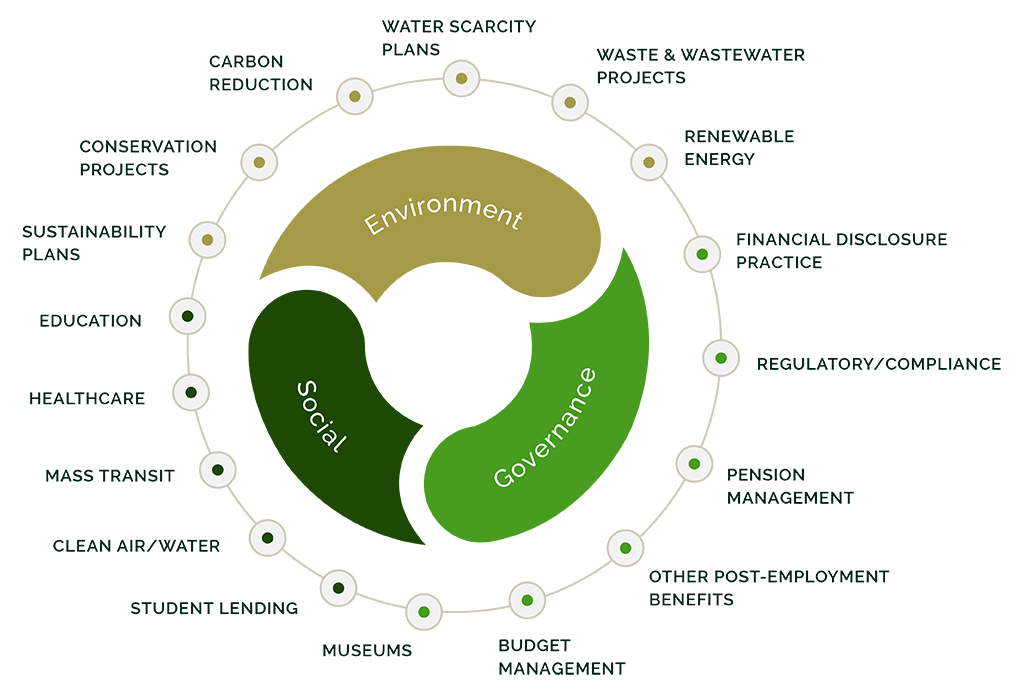
If you’re looking to achieve a positive impact on society while you grow your portfolio, you’re in luck. By embracing Environmental, Social, and Governance considerations, you can align your investments with your values.
Planning Perspective
Investing is also about taking steps to protect your financial future. Investors should develop a plan that addresses specific short- and long-term goals and that can be maintained and adjusted, as appropriate.
On the road to financial independence, you don’t have to go it alone and risk making the wrong projections. If you don’t have expertise in financial products and planning, a Financial Services Representative can help you make educated decisions and develop a plan.
Investors should consider the investment objectives, risks, charges, and expenses of mutual funds carefully before investing. This and other information are contained in the fund’s prospectus, which may be obtained from your investment professional. Please read it before you invest. Investments in mutual funds are subject to risk, including possible loss of the principal amount invested. All investments contain risk and may lose value. Investing in the bond market is subject to certain risks including market, interest rate, issuer, credit, and inflation risk. Equities may decline in value due to both real and perceived general market, economic, and industry conditions. CD rates are subject to change and availability and may be liquidated in the secondary market subject to market conditions. Generally, CDs may not be withdrawn prior to maturity. CDs are FDIC insured up to $250,000 per depositor per insured depository institution. Past performance is not a guarantee of future results.
Annuities
People are living longer and that means more time and savings will be spent in retirement. If you need a tax-deferred investment to provide a guaranteed1 stream of income for life or a specified number of years, it might be worth considering an annuity. An annuity is a contract between an insurance company and an annuity owner. In exchange for a purchase payment, or series of payments, the insurance company guarantees1 to pay a stream of income in the future.
There are two types of annuities—Immediate and Deferred.
An immediate annuity is usually purchased with a single premium and begins a stream of income within the first 12 months from the date of issue. You decide when payments will begin within that period and how long to receive income. There are two types of immediate annuities: fixed and variable.
A deferred annuity is specifically designed to help accumulate assets for retirement. It also offers the ability to turn those assets into a guaranteed stream of income at some point in the future. You decide when payments begin and how long to receive income. There are basically two types of deferred annuities: fixed and variable.
Variable annuities and their underlying variable investment options are sold by prospectus only. Investors should consider the investment objectives, risks, charges and expenses carefully before investing. This and other information are contained in the prospectus or summary prospectus, if available, which may be obtained from your investment professional. Please read it before you invest or send money.
Education Planning
If you find yourself intimidated by the ever-rising price of higher education, then a 529 college savings plan might be a key component in saving for a college education. A 529 college savings plan is a tax-advantaged way to save for college and pay for higher education expenses. Unlike some other savings vehicles, a 529 college savings plan may allow you to make sizeable contributions. The funds may generally be used for any qualified college or higher education expense, including tuition, room, board, fees, books, supplies, and equipment. Tax benefits are subject to certain restrictions and vary by state.
Money in a 529 college savings plan grows tax deferred, therefore you may be able to withdraw earnings without having to pay federal and state income taxes — depending on the plan and where you live — as long as it’s used to pay for qualified, higher-education expenses.1 If the money from 529 college savings plans is used for other purposes, the earnings portion of a withdrawal is subject to ordinary federal income tax, an additional 10% federal tax penalty on any earnings, and any applicable state income taxes. 529 college savings plans may also affect a student’s eligibility for financial aid.
Although many details of 529 college savings plans vary by state, they generally come in two forms:
529 plans are partially exempt from the gift tax. You can contribute up to $15,000 ($30,000 for married couples) annually2 per beneficiary, or up to $75,000 ($150,000 for married couples) over a five-year period, without triggering the gift tax.3
Keep in mind that your gifts are excluded from your estate, so investing in a 529 Plan can be a smart strategy to reduce your estate tax.
Funds may be withdrawn without the 10% federal penalty, up to a scholarship amount, if the beneficiary receives a scholarship or in the event of the death or disability of the beneficiary. Ordinary federal and state income taxes would be owed on any investment earnings included in gross income.
1 A federal 10% penalty may be imposed on the earnings portion of a non-qualified withdrawal in addition to ordinary income tax.
2 Annual exemption amounts are subject to revision by the Internal Revenue Service.
3 If the Account Owner utilizes the special five-year lump sum exclusion and dies within five years of the funding date, the portion of the contribution allocable to the years remaining in the five-year period (beginning with the year after the Account Owner’s death) would be included in the account owner’s estate for Federal estate tax purposes. Clients should consult their tax advisor.
Investments in 529 college savings plans are not deposits or obligations of any bank, are not guaranteed by any bank, are not insured by the FDIC or any other agency, and involve investment risks, including the possible loss of the principal amount invested.
Conditions, such as contribution limits, vary by plan and by state. 529 college savings plans are subject to market risk and volatility. Accounts may lose or gain value. Diversification does not assure a profit or protect against loss.
Related Services